Retaining Walls
Retaining Wall Basics: When You Actually Need One
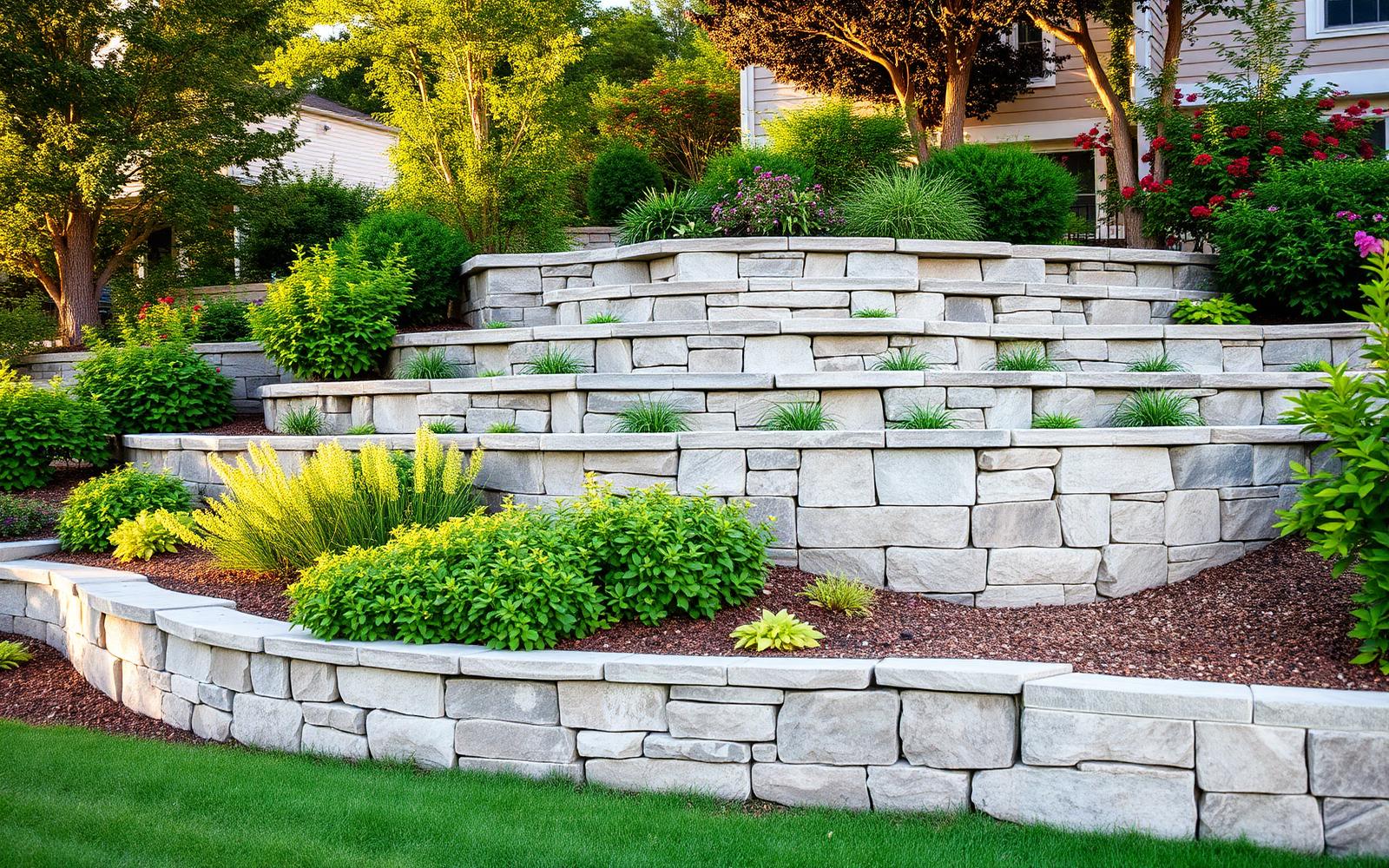
Most people think of retaining walls as a design choice. They can be — a well-built wall completely transforms a sloped yard. But more often, a retaining wall is a structural fix solving a real problem: soil that's moving where it shouldn't.
Signs you actually need one
- Soil is washing onto your patio, walkway, or driveway after heavy rain
- A slope on your property is sliding toward the house foundation
- You want usable flat space carved out of a hill
- An existing wall is leaning, bulging, or has cracks running through it
What makes a wall last
A retaining wall is 80% what you don't see. The block stack on top is the easy part. What keeps it standing is the base prep, the drainage behind it, and (for taller walls) geogrid tying it back into the hillside.
Base
We dig down below the frost line, lay 6-12 inches of compacted ¾-clear gravel, and screed it dead level. Skip this step and the wall settles unevenly within two winters.
Drainage
Behind every wall we install goes a perforated drain pipe wrapped in filter fabric, surrounded by clear stone. Hydrostatic pressure is what knocks walls over — give the water somewhere to go and your wall lasts decades.
Geogrid
Anything over about 4 feet of exposed height needs geogrid: layers of mesh laid back into the soil behind the wall. It turns the wall and the hill into one reinforced mass instead of a wall trying to hold the hill back on its own.
Permits
Most Waterloo Region and Brantford municipalities require a permit for walls over 1 metre (about 3'3"). We handle the permit application and engineering drawings when needed.
Thinking about a project like this?
Free, no-pressure consultation across Cambridge, Kitchener, Waterloo, Brantford and Guelph.
Get a free quote